Waterborne Polyurethane Dispersion as a New Green High Performance Material Choice
May 27, 2026
The Growing Importance of Waterborne Polyurethane Dispersions
In recent years, driven by stricter environmental regulations and increasing demand for high performance from downstream industries, Waterborne Polyurethane Dispersions have emerged as a star material in coatings, adhesives, textiles, leather, inks, and other fields, offering both eco-friendliness and excellent properties.
So, what makes PUD so special? What performance characteristics can it achieve? And in which applications can it be used? Let’s explore below.
What is Waterborne Polyurethane Dispersion?
A waterborne polyurethane dispersion is a polyurethane emulsion system using water as the dispersion medium. Through mechanical dispersion or self-emulsification, polyurethane prepolymers are uniformly dispersed in water to form stable polyurethane particles.
Compared with traditional solvent-borne PU, its main advantages are:
1.Low VOC / solvent-free
2.Safe, environmentally friendly, low odor
3.Suitable for applications with strict environmental requirements (e.g., shoe materials, leather, water-based inks)
Core Performance Characteristics of Waterborne Polyurethane
Waterborne PUD can balance softness and toughness, offering high design flexibility and a remarkable set of comprehensive properties.
1.Excellent Mechanical Properties
High strength and toughness, good abrasion resistance, and tunable tactile properties from soft to rigid through structural design.
2.Good Chemical & Weather Resistance
Good water resistance, oil and chemical resistance, and excellent anti-yellowing properties (especially for aliphatic PUD).
3.Good Film Formation
Fast drying, excellent low-temperature film formation, and compatibility with various resins (e.g., acrylics, epoxies).
4.Process-Friendly & Green
Easy to handle, suitable for multiple application processes, contains no or very low organic solvents, and is increasingly used in food contact materials (subject to regulations).
Typical Application Areas of Waterborne Polyurethane Dispersion
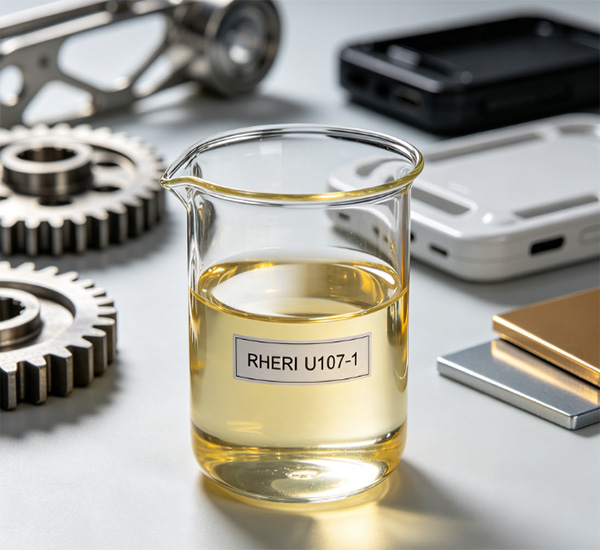
Our product RHERI U107-1 exemplifies these capabilities, especially in metal and plastic protective coatings. The versatility of waterborne PUD spans from industrial to consumer goods.
1.Leather Finishing & Synthetic Leather
Improves flexibility, hand feel, abrasion resistance, flex resistance, and hydrolysis resistance. Widely used in shoe upper leather, case leather, garment leather, etc.
2.Waterborne Adhesives
Used for shoe adhesives, furniture adhesives, and packaging adhesives, effectively replacing traditional solvent-borne PU adhesives with low odor, high safety, and tunable heat resistance.
3.Waterborne Wood Coatings & Industrial Coatings
Excellent scratch resistance, anti-yellowing properties, and transparency. Applied in furniture coatings, metal protection coatings, wheel hub coatings, etc. As a PUD for Metal and Plastic, RHERI U107-1 delivers strong adhesion, high hardness, and corrosion resistance on both substrates.
4.Textile Auxiliaries & Coatings
Provides water-repellent and breathable finishes, as well as scratch-resistant functional coatings. Commonly used in sportswear, outdoor gear, and functional fabrics.
5.Waterborne Inks & Overprint Varnishes
High transparency and gloss, improving abrasion resistance, folding endurance, and adhesion. Used in printing packaging and electronic product surface protection.
6.PUD for Building Waterproofing (Key Focus)
With rising demand for eco-friendly waterproofing materials in construction, waterborne PUD is becoming an important resin system for waterproof coatings.
Advantages of waterborne PUD in building waterproofing:
Excellent water resistance and hydrolysis resistance: The polyurethane chain forms a continuous dense film, effectively blocking water permeation, withstanding long-term immersion and water pressure.
High elongation and flexibility: Elongation up to 300–900% (depending on formulation), accommodating substrate shrinkage, micro-cracks, and thermal cycling.
Good weather resistance and aging resistance: Aliphatic systems exhibit excellent anti-yellowing, resisting chalking and cracking under outdoor exposure.
Strong application adaptability: Suitable for roller, trowel, and brush application; good adhesion to concrete and cement mortar; compatible with acrylics and various waterproof additives.
Eco-friendly and safe: Low VOC, low odor, suitable for indoor waterproofing (bathrooms, kitchens, balconies).
7.Special High-Growth Applications
3C product protective coatings, eco-friendly spray adhesives, waterborne PU elastomers, medical device surface coatings.
Key Factors Affecting Waterborne PUD Performance
To meet different application needs, PUD performance can be tuned through various structural design approaches:
Soft/hard segment ratio (more soft segments give more flexibility)
Type of diisocyanate (aliphatic for anti-yellowing, aromatic for higher mechanical strength)
Diamine chain extender composition
Presence of hydrophilic groups (e.g., DMPA)
Crosslinking (self-crosslinking or external crosslinker)
Precisely because of its high designability, PUD can cover so many industries.
Industry Trends: Why Is PUD Becoming Increasingly Popular?
Environmental regulations driving global VOC restrictions
End-user brands moving toward waterborne and sustainable solutions
Performance gradually catching up with or even surpassing solvent-borne PU
Rapid progress in domestic PUD technology with more competitive pricing
In the coming years, waterborne polyurethane will continue to penetrate more application fields.
Conclusion
As a Green High-Performance Material, waterborne polyurethane dispersion is in a phase of rapid development. It not only meets environmental trends but also serves as a powerful alternative to traditional solvent-borne materials, leveraging its outstanding properties. RHERI U107-1 stands as a reliable example of an Eco-friendly Resin for demanding protective coating applications.